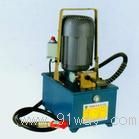
ZB series ultra-high pressure electric oil pump
1、 Main purpose and scope of application
The ZB series ultra-high pressure electric oil pump is an independent and complete hydraulic power device composed of a plunger pump, control valve, oil tank, motor, instrument, etc. It has the characteristics of small size, light weight, simple structure, easy operation, and high working pressure. When equipped with various specialized tools, it can meet the work requirements of lifting, bending, straightening, squeezing, scissors, riveting, dismantling, pressing, etc. As a hydraulic power component, it can also be installed in other mechanical equipment. This pump can achieve shutdown and pressure maintenance. Under the condition of no leakage in the external oil circuit, the shutdown and pressure maintenance can be carried out for 5 minutes, and the pressure drop should not exceed 5MPa.
2、 Main structure and working principle
The structure of the ZB series electric high-pressure pump is shown in Figure 1, and the oil circuit diagram is shown in Figure 2. Now it is described as follows:
1. High pressure pump:
The high-pressure pump station is a valve distribution axial quantitative piston pump, with 5-7 sets of piston pairs. The motor directly drives the pump shaft to rotate. Due to the action of the inclined plate, the plunger moves up and down along the plunger sleeve, and the oil is discharged through the oil valve, collected together, and enters the oil system.
2. Control valve:
The control valve consists of a one-way valve, a safety valve, an unloading valve, etc.
Turn the unloading valve handle clockwise to allow the oil to enter the system oil circuit. When the pressure rises to the rated pressure, the safety valve opens and the oil returns to the tank through the overflow port without further pressure increase. At this time, the motor can be turned on and off, and the pump can be stopped to maintain pressure without any leakage in the external oil circuit. Move the unloading valve handle counterclockwise to reduce the pressure to zero.
3. Directional valve:
The directional valve is a 34SM flat sealed rotary valve. Place the directional valve handle as indicated by the arrow to the A direction, where the A port supplies oil, and to the B direction, where the B port supplies oil. Can make the oil cylinder work back and forth.
3、 Common faults and troubleshooting methods Main causes of faults Troubleshooting methods
| Failure |
main reason |
Exclusion method |
| Insufficient pressure |
1. The adjustment value of the safety valve is too low, and the cone valve is stuck
2. Unloading valve steel ball damage or valve seat leakage
3. Loose joints or damaged seals causing leakage
4. Pressure gauge malfunction or damping blockage causing distortion of pressure response |
1. Adjust the safety valve, inspect the cone valve or valve seat
2. Replace the steel ball or repair (flatten) the valve seat
3. Fastener joints or replacement of seals
4. Check the pressure gauge and repair the pressure gauge seat |
| Insufficient traffic |
1. Excessive clearance due to plunger wear, plunger or spring breakage
2. Leakage in various places causes insufficient flow
3. Low oil temperature causes difficulty in oil absorption, while high oil temperature leads to a decrease in volumetric efficiency
4. Low liquid level, empty oil pump suction |
1. Replace the plunger or spring
2. Tighten the joint and replace the seal
3. Control the oil temperature between 20~70 ℃
4. Keep going
|
4、 Precautions for use and maintenance
1. The working medium of this pump is YC-N46D hydraulic oil, which can also be replaced with 32 # mechanical oil, but it is not allowed to switch to other grades of oil at will.
2. When using for the first time, after filling the oil tank, the motor should rotate clockwise. If necessary, please open the motor rain cover to see if it rotates in the positive direction, and jog the motor several times, idling for a few minutes to discharge the air in the oil circuit.
3. The liquid level in the fuel tank should be kept above the centerline of the fuel gauge to prevent the oil pump from being emptied. When refueling, use a 120 mesh filter to remove impurities from the oil. When frequently used, clean the oil filter every two months, clean the fuel tank every six months, and replace with new oil.
4. The normal working oil temperature is between 20-70 ℃. When the oil temperature is too high, cooling measures should be taken or the pump should be stopped, and it can only be used after the oil has cooled sufficiently; When the oil temperature is too low, direct operation is not allowed and heating measures need to be taken. The oil temperature can be increased by external heating or low-pressure operation.
5. Before starting the motor, the unloading valve needs to be opened to prevent motor overload. When the system has multiple directional valves and multiple outlets, it is even more important to open the unloading valve. After the oil pump is running normally, close the unloading valve, and then turn the directional control handle to switch the direction of oil flow.
6. The working pressure set for this pump at the factory must not be arbitrarily increased.
7. High pressure rubber hoses undergo a pressure test before leaving the factory, with a test pressure of 1.25 times the rated pressure. However, long-term use may cause damage to the rubber due to aging of the glue, resulting in a decrease in the pressure resistance strength of the hose. Regular inspections should be carried out, and those who use it frequently should check it every six months. During inspection, use a pressure test pump to apply pressure. If the pressure resistance is lower than 1.25 times the rated pressure, leakage, protrusion, or explosion occurs, it must be replaced. When using high-pressure hoses, it is important to avoid bending and sharp bends. Operators should be careful not to get too close to the hose to prevent it from exploding and throwing people up. Used in fixed situations, steel pipes can be used as a substitute.
8. This pump is inspected once a year. All parts should be cleaned with kerosene, and attention should be paid to protecting the surfaces of all accessories. They should not be bumped arbitrarily. After assembly, all moving parts should be flexible and free of local blockages.
5、 Main specifications and technical parameters
| Model |
work pressure |
High pressure flow |
Low pressure flow |
power |
| ZB63-0.27-1 |
63MPa |
0.27L/min |
1L/min |
0.55KW |
| ZB63-1-6 |
60MPa |
1L/min |
6L/min |
1.5KW |
| ZB63-1.5-7 |
63MPa |
1.5L/min |
7L/min |
1.5 KW |
| ZB63-2-7 |
63MPa |
2L/min |
7L/min |
2.2 KW |
| ZB63-4-10 |
63MPa |
4L/min |
10L/min |
4 KW |
| ZB63-6-12 |
63MPa |
6L/min |
12L/min |
5.5 KW |

 Your location:Home → Pump valve fittings → Pump products → Oil pump → ZB series ultra-high pressure electric oil pump

 Zoom in on the image
 Related Products:
 AOB-25 series oil pump motor
 Pump products
  pump head
 沪公网安备31010702003255号
