
 Your location:Home → instrumentation and meters → Level instrument → displacement sensor → WYD-1 type DC differential displacement sensor
 |
Product name: | WYD-1 type DC differential displacement sensor | |||||
| specification: |   Zoom in on the image Zoom in on the image |
||||||
| Category: | instrumentation and meters -- displacement sensor | ||||||
| |
Price: | factory price | |||||
| Brand: | Shanghai | ||||||
| Place of Origin: | China | ||||||
| |
Available Quantity: | batch | |||||
| delivery cycle: | Spot goods (or inquire by telephone) | ||||||
 |
|
||||||
| Main technical parameters | ||
|
Measurement range: |
± 0.5 (0-1), ± 1 (0-2), ± 2 (0-4), ± 5 (0-10), ± 10 (0-20), ± 20 (0-40), ± 25 (0-50), ± 35 (0-70) |
mm |
| Linearity: | <0.05 or<0.1 |
%F.S |
| Working power supply: | (Optional) ± 9, ± 12, ± 15,+24,+12,+5 | V |
|
Output signal: |
(Optional) ± 5V, ± 10V, 0-5V, 0-10V, 1-5V, 4-20mA | |
|
Frequency response: |
0~500Hz(-3db) | |
| Sensitivity: | 143~10000 | mV/mm |
|
Temperature coefficient: |
0.01~0.03 | %/℃ |
|
Operating Temperature |
-10~70 | ℃ |
|
Is it rebound type |
(Optional) Pop up or not pop up | |
|
Cable length: |
Free 2-meter configuration, also available upon request | |
|
Warranty period: |
24 months | |
Notes:
·Please do not cause deformation and bending of the moving iron core and measuring rod due to excessive directional force, otherwise it will seriously affect the flexibility of the measuring rod movement. The housing of the sensor is made of highly magnetic conductive material and should be protected from falling and impact. Please be careful when storing it.
·When clamping the sensor housing before measurement, it should be avoided from loosening, but excessive force should not be applied, and the housing should not be dented or deformed.
·The sensor measuring rod (head) should be in vertical contact with the measured object. The measured point should be on a plane with a certain degree of smoothness.
·The effective working range of sensors is generally located in the middle part of the active area of the measuring rod. The measuring rod has nonlinear working areas in the vicinity of both fully extended and fully compressed sections. When installing sensors, the clamping position of the sensor should be adjusted (moved) so that the displacement change does not exceed the effective measurement range. By observing displacement readings, the displacement can be kept within the predetermined range and the signal output should not exceed the rated range.
·If the measuring rod is found to be obstructed by dust or oil stains, please wipe and clean the measuring rod with an alcohol swab. However, the sensor should not be disassembled at will to avoid damage or reduced measurement accuracy.
·Before officially starting the experiment, please plug in the sensor and turn it on for preheating. Only start measuring after the reading stabilizes.
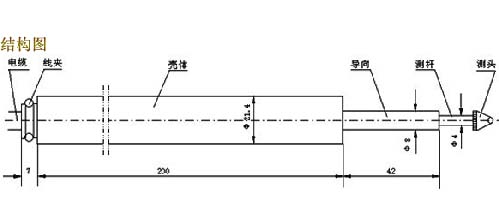
WYD-1 DC differential displacement sensor

 Related Products:
 HZ-821 Digital eddy current displacement sens.. DA displacement sensor JR20 series reed switch displacement sensor JM series magnetostrictive displacement senso.. ET Series ETH Magnetostrictive Displacement S.. GGD19 Rebound DC displacement sensor GD19 Universal DC displacement sensor GA09 series (miniature AC LVDT) displacement .. KTC Pull rod series displacement sensor KTM Micro Pull Rod Series Displacement Sensor.. Related articles:
 Electrical instruments Digital Display Instrument Temperature Instrument Humidity meter Pressure gauge flow meter analytical instrument Level instrument
  float ball Collimator Inclinometer Length measuring instrument linear scale level meter level gauge Hall switch Magnetic switch photoelectric switch proximity switch level switch Level switch Level transmitter Level controller level sensor Level transmitter level controller angle sensor displacement sensor
  Displacement transmitter vibration sensor tachometer Recording instrument weighing instrument Specialized instruments
 Home|Quality Commitment|Ordering|Payment method|product delivery|support|Disclaimer|Contact Us
Copyright®2011 www.91way.com Copyright.
Phone:+86-21-66770508 +86-13916500500 Fax:+86-21-66108310
Email:91way@163.com Wechat:40606422
沪ICP备2021005791号  沪公网安备31010702003255号

