
 Your location:Home → instrumentation and meters → Level instrument → level meter → LD800 series radar level gauge
 |
Product name: | LD800 series radar level gauge | |||||
| specification: |   Zoom in on the image Zoom in on the image |
||||||
| Category: | instrumentation and meters -- level meter | ||||||
| |
Price: | factory price | |||||
| Brand: | Shanghai | ||||||
| Place of Origin: | China | ||||||
| |
Available Quantity: | batch | |||||
| delivery cycle: | Spot goods (or inquire by telephone) | ||||||
 |
|
||||||
Intelligent radar level gauge
Measuring principle
Extremely short microwave pulses with low emission energy are transmitted and received through an antenna system. Radar waves travel at the speed of light. The running time can be converted into level signals through electronic components. A special time extension method can ensure stable and accurate measurements in a very short period of time.
Even in complex working conditions where false echoes exist, the latest microprocessing technology and debugging software can accurately analyze the echoes of the material level.
Input
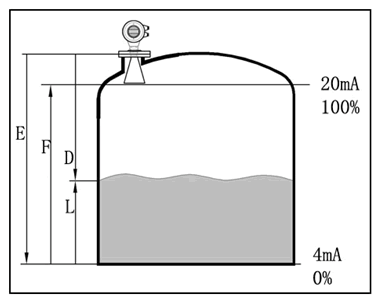
The antenna receives reflected microwave pulses and transmits them to the electronic circuit. The microprocessor processes this signal and identifies the echoes generated by the micro pulses on the surface of the material. The correct recognition of echo signals is completed by intelligent software, with an accuracy of up to millimeter level. The distance D from the surface of the material is proportional to the time travel T of the pulse:
D=C×T/2
Where C is the speed of light
Since the distance E of the empty tank is known, the level L is:
L=E-D
output
By inputting the empty tank height E (=zero), full tank height F (=full range), and some application parameters to set, the application parameters will automatically adapt the instrument to the measurement environment. Corresponding to 4-20mA output.
Application medium:
The LD800 series radar level gauge is suitable for non-contact continuous measurement of the level of liquids, slurries, and particulate materials, and is suitable for large temperature and pressure changes; In situations where inert gases and volatiles are present.
The measurement method adopts microwave pulses and can operate normally within the industrial frequency range. The beam energy is low and can be installed in various metal and non-metal containers or pipelines, without causing harm to the human body and the environment.
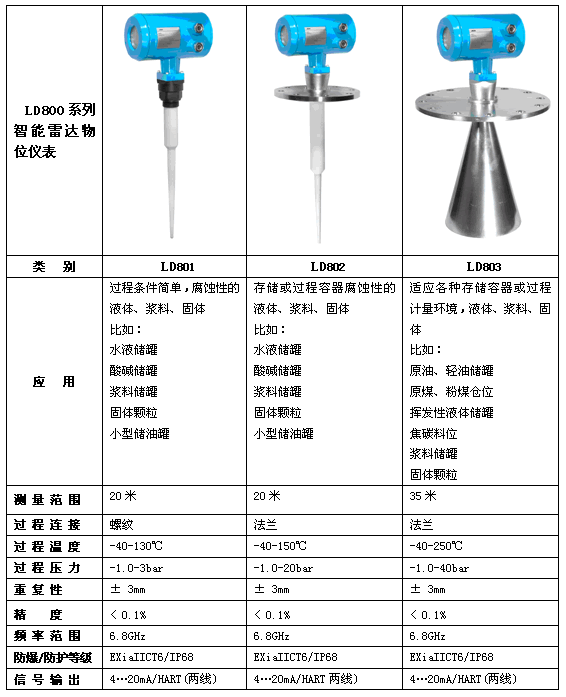
LD800 series radar level gauge

 Electrical instruments Digital Display Instrument Temperature Instrument Humidity meter Pressure gauge flow meter analytical instrument Level instrument
  float ball Collimator Inclinometer Length measuring instrument linear scale level meter
  level gauge Hall switch Magnetic switch photoelectric switch proximity switch level switch Level switch Level transmitter Level controller level sensor Level transmitter level controller angle sensor displacement sensor Displacement transmitter vibration sensor tachometer Recording instrument weighing instrument Specialized instruments
 Home|Quality Commitment|Ordering|Payment method|product delivery|support|Disclaimer|Contact Us
Copyright®2011 www.91way.com Copyright.
Phone:+86-21-66770508 +86-13916500500 Fax:+86-21-66108310
Email:91way@163.com Wechat:40606422
沪ICP备2021005791号  沪公网安备31010702003255号


