
 Your location:Home → instrumentation and meters → tachometer → Speed recorder → SQY05T105 Speed digital display instrument
 |
Product name: | SQY05T105 Speed digital display instrument | |||||
| specification: |   Zoom in on the image Zoom in on the image |
||||||
| Category: | instrumentation and meters -- Speed recorder | ||||||
| |
Price: | factory price | |||||
| Brand: | Shanghai | ||||||
| Place of Origin: | China | ||||||
| |
Available Quantity: | batch | |||||
| delivery cycle: | Spot goods (or inquire by telephone) | ||||||
 |
|
||||||
1、 Overview:
SQY05T105 speed digital display instrument, with 4-digit LED digital tube display. This speed digital display instrument can be matched with various speed sensors such as proximity switches, Hall sensors, photoelectric sensors, and magneto electric sensors to measure frequency, speed, flow rate, and linear velocity; This speed digital display instrument has a 4-20mA output, and can output parameters such as full range, measurement equivalent, and sampling time, which can be adjusted through panel keys as needed.
The biggest feature of this speed digital display instrument is its compact structure, flexible installation method, and powerful functionality; It can be used as a frequency, speed, flow, and linear velocity display instrument, as well as for frequency current conversion, especially for measuring ultra-low speeds (frequency, flow, and linear velocity); Widely used in industries such as machinery, chemical engineering, metallurgy, energy, light industry, textiles, electronics, and automobiles.
Please read carefully before use in order to effectively and reasonably use the display device.
2、 Main technical performance:
1. Power supply: 85V~250V, AC, 50/60Hz
2. Input frequency: rectangular wave: 0.001Hz-9999Hz
Sine wave: 10Hz~9999Hz
3. Signal amplitude: Rectangular wave: H>4V, L<3V (matched with NPN-OC and push-pull output)
Sine wave: 0.3V~20V (AC RMS)
4. Measurement range: Speed range of 3-9999r/min
Frequency: 0.001Hz-9999Hz
5. Display range: 0.001 to 9999
6. Basic error: 0.03% (numerical quantity)
0.2% (analog quantity)
7. Operating environment: Temperature range of 0-50 ℃
Relative humidity ≤ 95%
8. Hole size: 45 × 45
9. Dimensions: 48 × 48 × 90
10. Installation method: 35mm track or 45 × 45 perforated disc installation
11. Weight: less than 500g
3、 Operating instructions:
Before formal use, power on the display device and it should display "8888." Within 5 seconds, it should display "0000";
2. Parameter A is set to 1.0 at the factory, and parameter D is set to 5000 at the factory;
3. Wiring diagram:
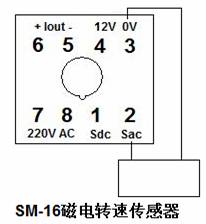
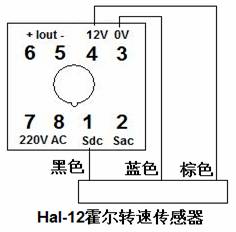
7. 8: Instrument working power input terminal; The acceptable working power supply is 85V-220V, AC, 50/60Hz;
4. 3: Power supply terminal: It can provide 12V-15V DC power to NPN type OC type output speed sensors;
1. 3. 4: Connect the three output wires of the NPN type OC sensor;
2. 3: Connect the two signal output terminals of the magneto electric sensor.
6. 5:4-20mA current output terminal.
4. Parameter setting:
a. The "SET" key is a parameter query/setting gear shift key. Press the "SET" button to enter the setting/query state, and continue pressing the "SET" button to display A, B, C, D, E, and F in sequence; The highest digit and letter are displayed alternately.
b. The "◄" key is the left shift key. Press the "◄" button in order to flash or display decimal points in units, tens, hundreds, and thousands.
c. ▲ "is the plus 1 key. Press the "▲" button to increase the flashing position by 1; When the decimal point is displayed, press the "▲" key to move the decimal point to the left; When the E mode is displayed and a decimal point appears, press the "▲" key to confirm the parameter modification and save it, while exiting the setting state.
d. This instrument has six parameters: A, B, C, D, E, and F; A represents the measurement equivalent (factory set to "1.0"); B is the output zero adjustment value (factory set to "794"), a factory parameter that users do not need to modify; C is the output linear value (factory set to "3200"), a factory parameter that users do not need to modify; D is the full range (factory set to "5000"), and the decimal point position of the D parameter determines the decimal position of the displayed measurement results. The D parameter is a user parameter that can be modified as needed; When the decimal point of parameter E appears, ask the user if the parameter needs to be modified. If it needs to be modified, press the "▲" key to complete the parameter modification and exit the setting/query state. If it does not need to be modified, press the "RST" key to exit the setting/query state.
The E parameter value represents the sampling time of the measurement, which can be selected within the range of 0.1 to 25.0 seconds, indicating a sampling time of 0.1 to 25.0 seconds.
The F parameter is the extension multiple of the sampling time, which can be selected within the range of 1 to 250. When the lowest bit is an even number, Sac is selected as the signal input, and when the lowest bit is an odd number, Sdc is selected as the signal input.
When the period of the input signal is greater than E × F, the instrument displays "0000". E. The reasonable selection of F enables the speed digital display instrument to respond quickly at higher speeds (frequency, flow rate, speed) and also measure ultra slow speeds (frequency, flow rate, speed).
e.“SET”、 The combination of the "◄" and "▲" keys can set each parameter bit by bit, and the decimal point can be moved to achieve any number setting within 0.001 to 9999.
f. The RST key serves as the reset key.
3. Parameter calculation method:
This instrument converts physical quantities such as rotational speed, angular velocity, and linear velocity into pulse frequencies through corresponding sensors, and then measures them. The final step is to measure the frequency and multiply it by an appropriate coefficient to enable the instrument to directly read the physical quantity.
The calculation formula for equivalent A during speed measurement is: A=60/P
A represents the equivalent of speed measurement
P represents the number of pulses emitted by the sensor per revolution
Here is an example to illustrate the method of exporting equivalent A:
Assuming the object being measured rotates once and the sensor emits two pulses, then:
A=60/P=60/2=30
The coefficient derived from this is 30, which can be set to 30.0 during setup.
4. Analog quantity calculation method:
Current output (mA)=(measured value/full range) × 16+4.0
5. Provide examples to illustrate the settings of coefficients and parameters.
Set coefficient A to 2.345 and parameter D to xxx.xx.
Press the "SET" button. When A appears, press the "◄" shift button. When the position flashes, press the "▲" button to increase the position to 5; Press the "◄" shift key again, and when the ten digits flash, press the "▲" key to increase the position to 4; Press the "◄" shift button again, and when the hundred digits flash, press the "▲" button to increase the position to 3; Press the "◄" shift key again, and when the thousand digit is flashing, press the "▲" key to increase the digit to 2. Press the "◄" shift key, and when the decimal point appears, press the "▲" key to move the decimal point to the left, making A 2.345.
Press the "SET" button, and when D appears, set the decimal place and full range of the displayed value in the same way as A.
Press the "SET" button, when E appears, press the "◄" shift button until the decimal point appears, then press the "▲" button to confirm and save the set parameters, and exit the setting state.
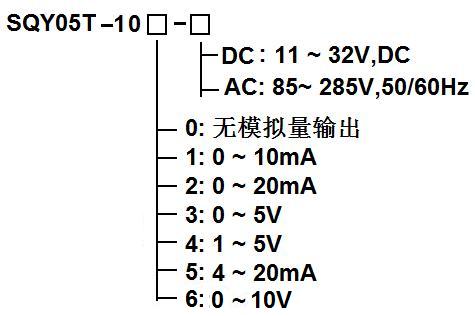
Selection diagram:

 Related Products:
 ESG type capacitive high-voltage live display.. CG5-35KV Indoor high-voltage live display dev.. CG5-10Q Indoor high-voltage live display devi.. CG5-10Q/95/(135.140.145) Indoor high-voltage .. L-3 Indoor high-voltage live display device DXN-10T(Q) series indoor high-voltage live di.. DXN-T series indoor high-voltage live display.. DXN-Q type indoor high-voltage live display d.. DXN-35Q type charged display device VPIS) series indoor high-voltage live display.. Related articles:
 Electrical instruments Digital Display Instrument Temperature Instrument Humidity meter Pressure gauge flow meter analytical instrument Level instrument tachometer
  tachometer speedometer anemometer Line speedometer odometer accelerometer speed sensor Speed recorder
  speed controller Speed Transmitter Accelerometer Recording instrument weighing instrument Specialized instruments
 Home|Quality Commitment|Ordering|Payment method|product delivery|support|Disclaimer|Contact Us
Copyright®2011 www.91way.com Copyright.
Phone:+86-21-66770508 +86-13916500500 Fax:+86-21-66108310
Email:91way@163.com Wechat:40606422
沪ICP备2021005791号  沪公网安备31010702003255号

